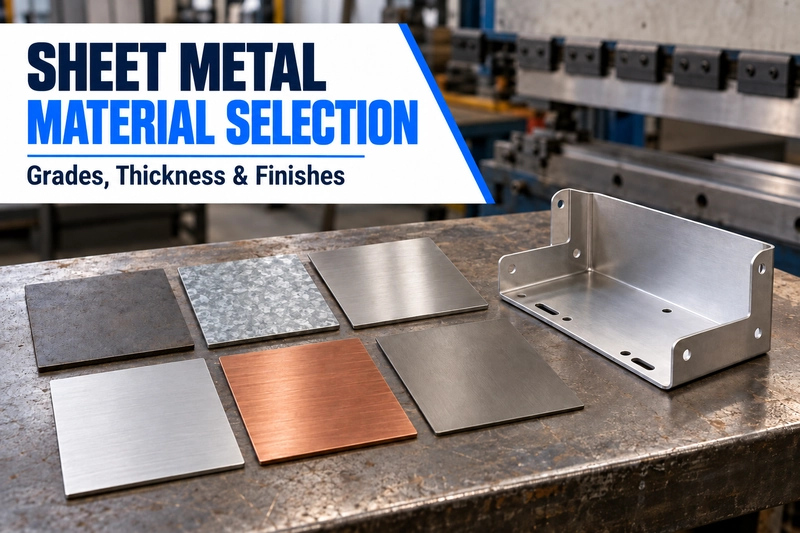
Sheet metal material selection for custom parts starts with the part's function and operating conditions. Specify the grade, temper or condition, thickness, manufacturing method and finish together. First establish the loads, allowable deformation and exposure conditions; then compare candidate materials against those requirements.
Two parts described simply as “aluminum” or “stainless steel” may require different bending, welding and delivery conditions because their grades, tempers and surface requirements differ. Selecting a material family is only the beginning of a usable specification.
This guide is for designers, engineers and buyers selecting materials for custom sheet metal parts. It provides comparisons tied to specific grades and conditions, and explains how to choose thickness, identify an existing part's material and prepare an RFQ. The focus is on panels, enclosures, frames and mounting parts that require cutting, forming or joining. The numerical comparison focuses on sheet up to 6 mm thick, subject to the product and thickness conditions stated in each row.
Start with the Part's Requirements
Identify the conditions that would make the part unacceptable. An enclosure may be governed mainly by appearance, cleaning and protection requirements. A mounting plate may depend more on flatness, fixing positions and deflection under load. An electrical connection needs suitable current capacity, contact surfaces and a reliable joint.
At a minimum, establish:
- How loads enter the part, how it is fixed, how much deformation is acceptable, and whether impact or repeated vibration is present.
- Whether the environment includes rain, salts, cleaning agents or other chemicals, together with the operating temperature and cleaning method.
- Weight limits, electrical contact, grounding or heat transfer requirements, and the surfaces that must meet appearance criteria.
- Required bends, welds, self-clinching fasteners or other connections, along with quantity and delivery requirements.
These requirements help eliminate unsuitable options early. An enclosure washed regularly and a support plate used in a dry indoor location should not automatically receive the same material and finish just because their shapes are similar.
Shortlist Materials by Project Requirement
If the material is undecided, use the following table to identify options worth comparing before checking their grades, tempers and properties. It is an initial shortlist, rather than a recommendation for every part in that application.
| Project requirement | Material options to compare first | Conditions that determine the choice |
|---|---|---|
| Dry indoor enclosures or general mounting parts | Cold-rolled carbon steel with a suitable coating; pre-galvanized sheet is another option | Stiffness, appearance, protection after cutting and welding, and finished-part cost |
| Washdown, salt or chemical exposure | Stainless steels such as 304 and 316L; assess other protective systems against the environment | Medium, concentration, temperature, retained liquid, crevices and cleaning method |
| Low weight with multiple bends | Forming alloys such as 5052-H32 sheet | Bend radius and direction, allowable deformation and connections; compare other tempers for more demanding forming |
| Low weight with higher strength requirements | Aluminum sheet such as 6061-T6, assessed together with the structural design | Both strength and stiffness; tight bends and local properties after welding |
| Electrical connections or grounding parts | Copper or aluminum suitable for the electrical application | Conducting cross-section, contact finish, joint reliability and contact between dissimilar metals |
| Specific corrosion conditions that common options cannot satisfy | A suitable titanium grade or another corrosion-resistant candidate | Actual medium and temperature, grade, forming and welding route, and supply conditions |
A requirement can have several workable material solutions. Preserve the necessary function before comparing manufacturing constraints. Weight reduction requires more than a density comparison, and corrosion selection requires more information than “outdoors” or “exposed to water.”
Compare Common Sheet Metal Materials
This table supports initial screening. It is not a fixed ranking of strength, service life or cost. Cold rolling describes how the supplied material is processed, while galvanizing describes a coating; both can apply to the same carbon steel substrate.
| Material or supply form | Reasons to consider it | Main checks before selection |
|---|---|---|
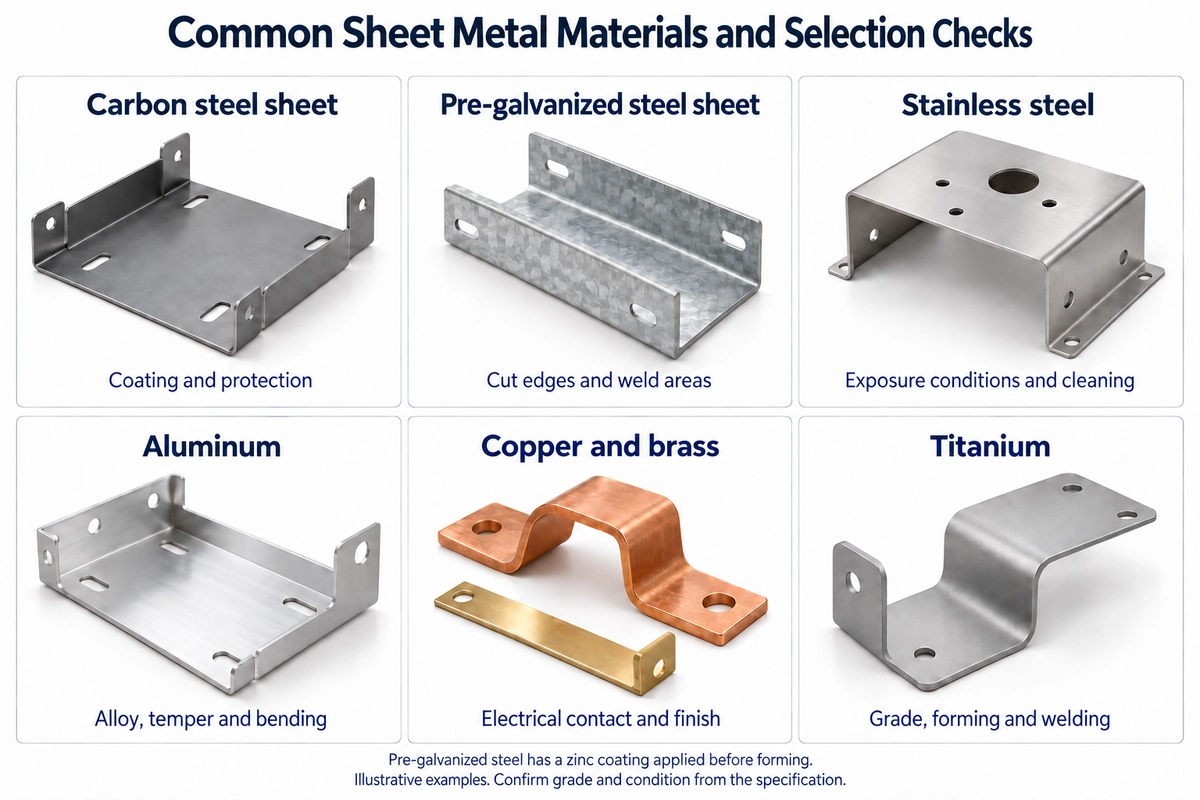
| Carbon steel sheet, including cold-rolled forms | Panels, frames and mounting parts that need forming, welding and cost control | Grade and condition, incoming surface, and protection after cutting and welding |
| Pre-galvanized steel sheet | Combines a steel substrate with a zinc coating already applied before fabrication | Coating specification, cut-edge and weld protection, surface after bending, and compatibility with later coating |
| Stainless steel | Corrosion resistance, cleaning and maintenance, or a visible metallic finish | Medium and temperature, grade, post-weld surface treatment and visible grain direction |
| Aluminum alloys | Weight limits combined with forming, heat transfer or appearance requirements | Alloy and temper, deflection limits, bending and welding conditions, and functional surfaces after finishing |
| Copper and brass | Copper for electrical or heat-transfer parts; brass for some formed or decorative components | Grade and temper, electrical contact requirements, surface changes and finished-part cost |
| Titanium and titanium alloys | Specific corrosion conditions or a combination of strength and weight requirements | Grade, condition, product form, forming and welding requirements, procurement and manufacturing cost |
Select Stainless Grades for the Medium and Temperature
Stainless steels such as 304, 316L and 430 differ in composition and performance. Molybdenum-containing 316L can offer better corrosion resistance in some chloride-containing environments, but “outdoor,” “chemical service” or “coastal” is not enough to select a grade.
Specify the medium, concentration and temperature, whether liquid can collect or crevices can form, and how the part will be cleaned and maintained. Outokumpu's corrosion selection data evaluates materials under defined conditions; results for one medium cannot be applied to every environment.
Specify Both the Aluminum Alloy and Temper
5052-H32 is commonly considered for bent sheet metal parts. 6061-T6 can be useful where strength and machining requirements justify it, but tight bends need particular attention to cracking risk. The alloys cannot be substituted simply because both are aluminum.
An option that is easier to form still needs a fresh check of finished-part strength, deformation, connections and weight. Changing the grade while keeping the original thickness and every geometric feature does not necessarily preserve performance.
Distinguish Commercially Pure Titanium from Titanium Alloys
Titanium can be considered where corrosion resistance, weight and mechanical properties must be assessed together. Under comparable annealed sheet conditions, commercially pure Grade 2 is generally easier to form than Grade 5 Ti-6Al-4V. Grade 5 offers higher strength, with forming conditions that need closer assessment.
For sheet parts, evaluate the grade, condition, springback and permitted bend geometry together. Routes such as hot forming may need consideration. Forming requirements for one grade should not be applied to all titanium materials.
Welding also brings shielding and cleanliness into the process assessment. TIMET's titanium design and fabrication handbook discusses these factors separately. High strength alone does not justify copying the manufacturing route of an existing steel or aluminum part.
Use Data to Compare Strength, Weight and Stiffness
The following examples compare sheet under stated grade, condition and product requirements. “≥” and “≤” indicate lower and upper limits; a range preserves both limits. Procurement and acceptance still require an agreed standard, product specification and material documentation.
Mechanical Property References for Selected Sheet Materials
These are room-temperature tensile properties, with strengths in MPa. Rp0.2 is the 0.2% proof strength. For DC01 with a distinct yield point, the relevant value is the lower yield strength ReL; the listed value is a conditional upper limit, not a minimum design strength. Rm is tensile strength. Elongation retains the source's gauge length. “Not stated” means the cited row does not specify a gauge length and should not be ranked directly against A50 or A80. Where thickness bands are not listed, confirm the requirements for the ordered thickness with the supplier. Do not apply the Grade 5 elongation value below 0.635 mm.
| Grade and condition | Product or thickness conditions | Yield or Rp0.2 (MPa) | Tensile Rm (MPa) | Elongation |
|---|---|---|---|---|
| DC01 cold-rolled steel | SSAB DC01 Zero; 0.7 < t ≤ 3.0 mm | Upper limit ≤280; within 8 days of product availability | 270–410 | A80 ≥28% |
| 304 / 1.4301 stainless steel | Cold-rolled sheet/coil; EN 10088-2; confirm thickness | ≥230 | 540–750 | A80 ≥45% |
| 316L / 1.4404 stainless steel | Cold-rolled sheet/coil; EN 10088-2; confirm thickness | ≥240 | 530–680 | A80 ≥40% |
| 5052-O aluminum | Annealed; 1.21–6.0 mm | ≥65 | 170–215 | A50 ≥19% |
| 5052-H32 aluminum | H32; 1.21–6.0 mm | ≥160 | 215–265 | A50 ≥7% |
| 6061-T6 aluminum | Sheet/strip; 1.5 < t ≤ 3.0 mm | ≥240 | ≥290 | A50 ≥7% |
| Cu-ETP copper | CW004A / C11000; R240/H65 | ≥180 | 240–300 | A50 ≥8% |
| Grade 2 commercially pure titanium | Mill annealed; confirm thickness | 275–450 | ≥345 | ≥20%, 2-inch gauge length |
| Grade 5 titanium alloy | Annealed Ti-6Al-4V sheet; 0.635–6.0 mm | ≥828 | ≥895 | ≥10%, gauge length not stated |
Different tempers of the same alloy also matter. In the table, 5052-H32 has a higher minimum proof strength than 5052-O but a lower minimum elongation in the same thickness band. Check both the strength needed in service and the deformation required during fabrication, rather than selecting the largest strength value.
Density and Elastic Modulus References
These are typical or approximate values near room temperature, rather than minimum acceptance requirements. Density helps estimate weight for the same volume. Elastic modulus E helps assess elastic deformation, together with geometry and fixing conditions. A modulus range reflects differences such as material condition; calculations need a value appropriate to the actual supplied material.
| Material reference | Approximate density (g/cm³) | Reference elastic modulus E (GPa) |
|---|---|---|
| Ordinary carbon steel, general reference | 7.85 | 200–210 |
| 304 / 1.4301 stainless steel | 7.9 | 200 |
| 316L / 1.4404 stainless steel | 8.0 | 200 |
| 5052 aluminum | 2.68 | 70 |
| 6061 aluminum | 2.70 | 70 |
| Cu-ETP copper, soft condition | 8.9 | 130 |
| Grade 2 commercially pure titanium | 4.51 | 105–120 |
| Grade 5 Ti-6Al-4V | 4.42 | 107–122 |
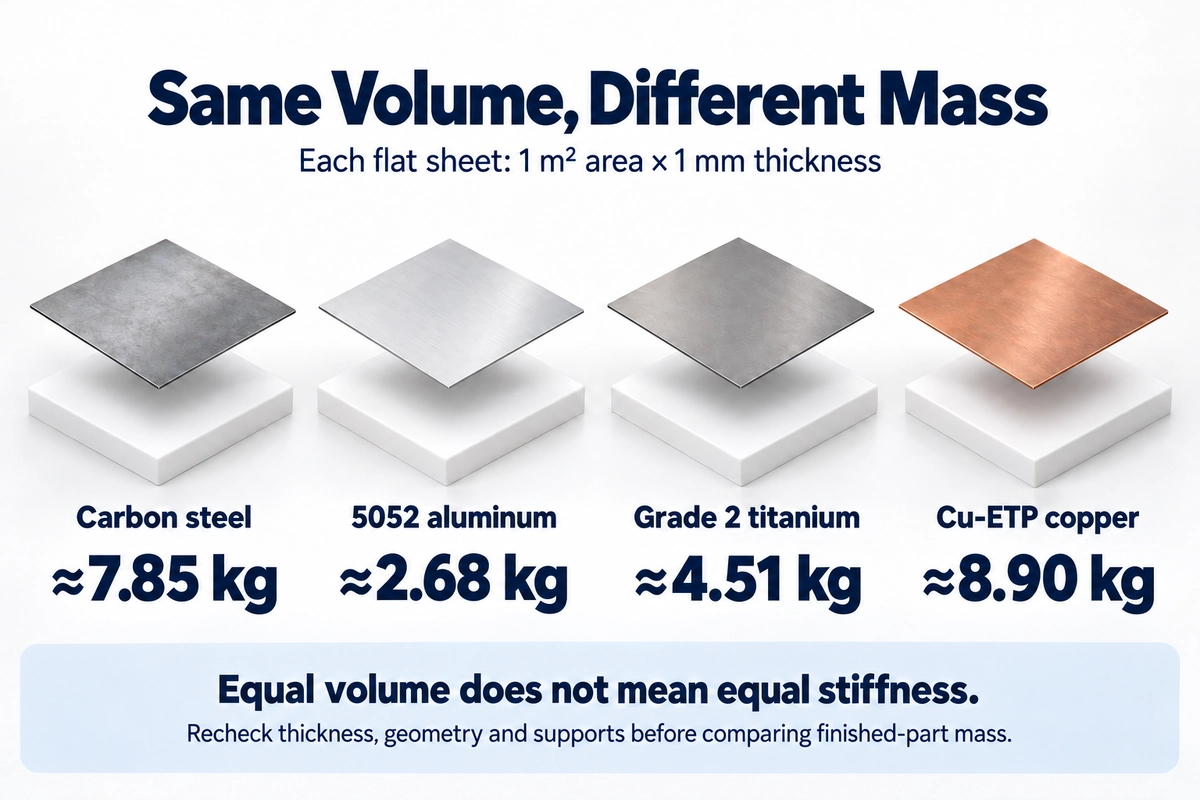
For example, an unperforated flat sheet with an area of 1 m² and a thickness of 1 mm weighs approximately 7.85 kg in carbon steel or 2.68 kg in 5052 aluminum using these densities. This compares equal volume only. If thickness or reinforcement changes to satisfy stiffness requirements, recalculate the finished-part weight.
Turn a Material Name into a Complete Specification
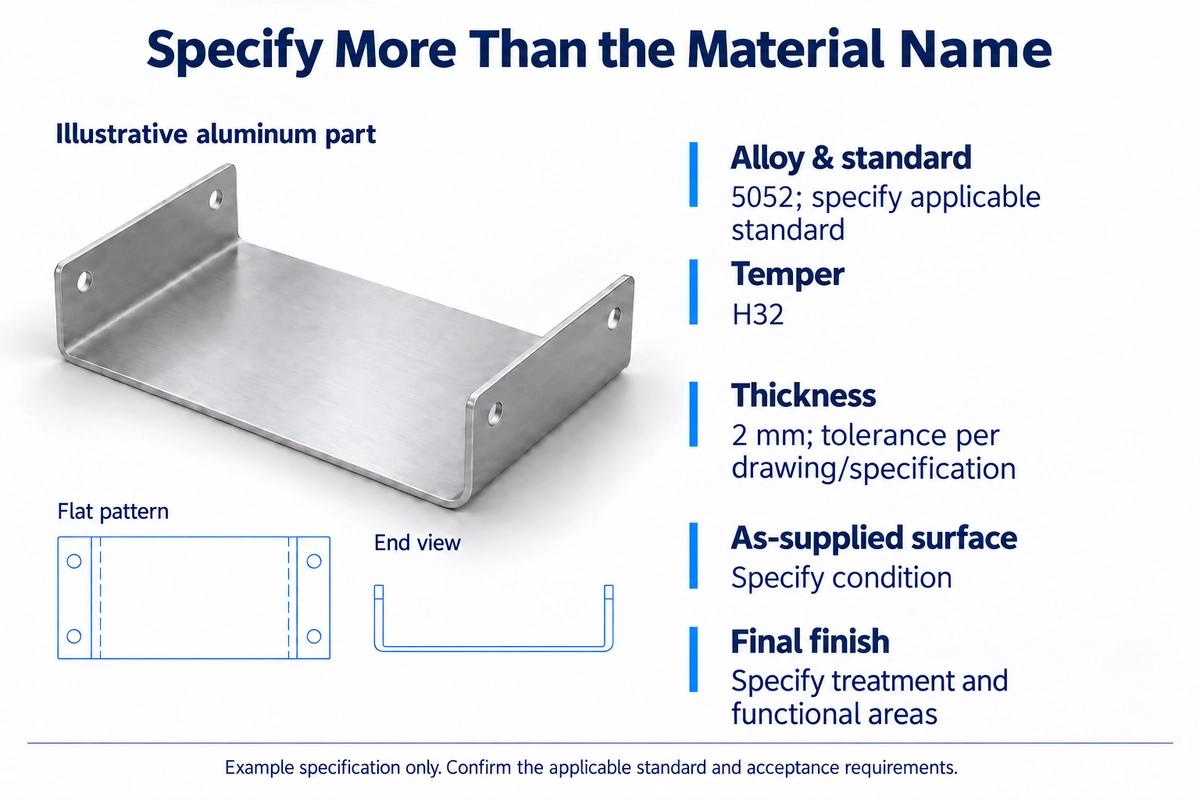
“Carbon steel,” “cold-rolled,” “5052-H32” and “2B” describe different information. Separating these requirements reduces misunderstandings between the drawing, quotation and supplied material.
| Specification level | Example | What it establishes |
|---|---|---|
| Material family | Carbon steel, stainless steel, aluminum alloy, titanium | An initial material family, without defining all properties |
| Material standard and grade | Grades such as SPCC or DC01 with their applicable standards | Specific material requirements; these examples are not an equivalence table |
| Material condition | H32, T6, annealed | Processing or heat-treatment condition that can affect forming and mechanical properties |
| Thickness and tolerance | Nominal thickness and permitted variation | Thickness conditions for geometry, fit and manufacturing calculations |
| Supplied surface and final finish | 2B, brushed, pre-galvanized, powder coated | Incoming surface, visible surface or final treatment; specify these separately |
A usable specification normally includes the material standard and grade, condition, nominal thickness and tolerance, supplied surface, final finish and any permitted substitutions. Add material documentation and inspection requirements where applicable.
For example, “2 mm aluminum sheet” provides a thickness, but the manufacturer still needs the alloy, temper, surface and thickness tolerance to identify the required stock.
Similar grades from different national standards should not be treated as equivalent solely on the basis of an online cross-reference. Check the product form, condition, composition and mechanical requirements, then confirm that assembly, finish and acceptance requirements permit the proposed substitution.
Select Material and Thickness Together
Thickness must meet the part's functional requirements and suit fabrication. Tensile strength data and supplier thickness ranges help with initial screening, but neither directly determines the thickness of a particular part.
Separate Strength from Deflection Requirements
Strength concerns the onset of yielding or failure; stiffness concerns how much a part deforms under load. A part can remain free of permanent deformation yet deflect enough to affect clearance, sealing or location.
SSAB's structural stiffness guidance distinguishes material strength from stiffness. Elastic deformation depends on modulus, section geometry, span and support conditions, not strength alone.
For panels with long unsupported spans, consider flanges, reinforcement or support positions. For loaded mounting parts, also check load position, holes and connections. Compare increased thickness with these changes. Our sheet metal bracket design guide discusses mounting geometry in more detail.
Check Forming and Connections
Once a candidate thickness is selected, review bend radii, short flanges, hole and slot positions, and tool access. Alloy, temper, material direction and actual forming conditions all affect the outcome. One thickness multiplier will not suit every material.
Welding can affect deformation and local properties. Self-clinching and other fasteners also have material, thickness and hole requirements. Recheck those connections after a material change, rather than updating only the material note on the drawing.
Confirm the Thickness That Can Be Supplied
Stock thicknesses affect procurement and manufacturing arrangements, but one supplier's range is not a universal range for the material. The drawing, model and quotation should use consistent thicknesses. A nearby stock thickness requires a fresh check of fit and function before substitution.
If thickness is expressed in gauge, identify the material and conversion system. The same gauge number can represent different thicknesses in different materials. State the intended millimeter or inch thickness and its tolerance on the drawing as well.
Check Finishes against the Part's Function
Finishing affects protection and appearance, and can also affect connections, dimensions and maintenance. Identify which surfaces must be protected or preserved when comparing options.
Include Cut Edges and Welds in the Protection Plan
Pre-galvanized sheet is coated before fabrication. Batch hot-dip galvanizing after forming is a different route. Cut edges, weld areas, coverage and design requirements differ, so “galvanized” alone is not a complete specification.
Powder coating carbon steel also requires an assessment of pretreatment, coating system, edge coverage and exposure. Compare completed solutions: how the incoming surface, fabrication process and final protection work together, rather than bare-material corrosion resistance alone.
Specify Electrical Contact Areas Separately
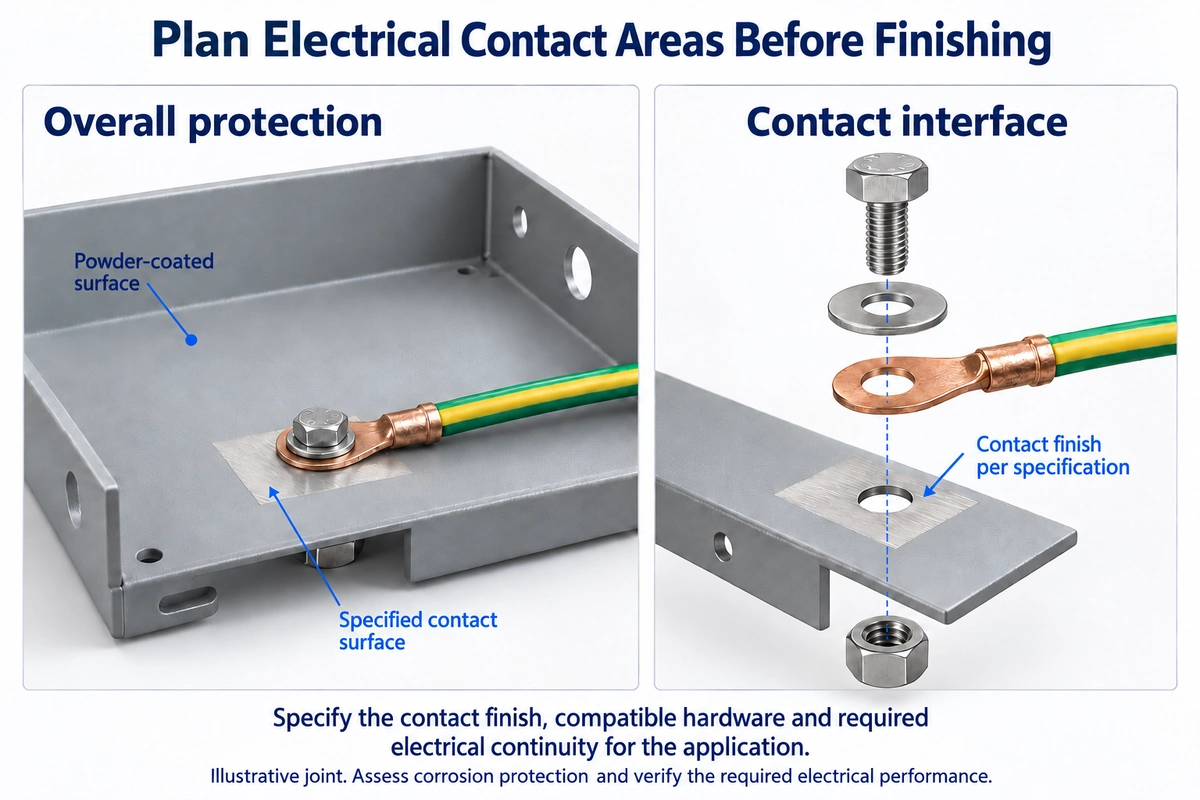
The conductivity of copper or aluminum as a substrate does not establish the contact performance after finishing. Powder coating or anodizing can affect grounding and electrical connections. Identify the areas that require electrical contact, including any masking or other connection measures.
Assess heat transfer separately from electrical contact. Thermal conductivity, actual contact, surface condition and the overall structure all affect heat transfer. Selecting anodized aluminum does not mean every surface is suitable for electrical connection.
Define Fit and Appearance before Finishing
Coatings can change dimensions at holes, threads and assembly interfaces. Anodizing also requires consideration of dimensional change. Identify whether critical dimensions apply before or after finishing and which mating surfaces need protection. See our sheet metal drawing tolerances guide for dimensioning considerations.
For visible surfaces, agree on grain direction, color, gloss, permitted fabrication marks and inspection samples. “Brushed” or a color name alone is usually insufficient to define the appearance consistency of adjacent panels.
Confirm Material Identity when Reproducing or Replacing an Existing Part
For a new design, first select candidate materials for the required performance, then specify the standard, grade and condition. For an existing part, first check drawings, material certificates, purchase records and markings, and establish whether those records are traceable to the sample. If records are insufficient, select an appropriate identification method.
Color, perceived weight and magnet response can provide clues, but cannot independently identify a grade. ASSDA's guidance on grade confirmation explains that appearance cannot reliably distinguish stainless grades, and some austenitic stainless steels can become magnetic after cold working.
Define what must be identified before choosing a test method. Handheld XRF can identify some alloying elements, but cannot measure carbon. It cannot, by itself, confirm whether 316 is the low-carbon 316L grade. Thermo Fisher's comparison of material identification methods explains this limitation.
Composition consistent with a grade does not confirm the material condition or all mechanical properties. Where strength, hardness or another property determines suitability, use material documentation and appropriate further verification.
If the original material cannot be established accurately, an alternative can be proposed against the part's function, with design and acceptance requirements reassessed. Identical shape does not establish identical load or corrosion performance.
Compare Finished-Part Cost on the Same Delivery Requirements
Material price is only part of the cost. Before comparing materials, agree on the same function, quantity, surface and acceptance requirements. Then assess material utilization, cutting, forming, joining, finishing and inspection.
For a painted indoor enclosure, for example, compare carbon steel with appropriate pretreatment and powder coating against other materials delivering the same function. Corrosion or weight requirements may also change thickness, structure, manufacturing steps and later maintenance.
Readily available grades and thicknesses can help manage delivery. Include special conditions, documentation or appearance requirements in the same comparison. Any material-price estimate needs a defined grade, condition, quantity and purchasing basis, followed by fabrication and finishing costs.
Prepare a Material Selection Brief for Discussion
For an RFQ, prepare:
- Drawings or a model, together with the part's purpose, fixing method and important assembly relationships.
- Agreed standards, grades, tempers and thicknesses; for undecided items, state the functional targets and constraints.
- Environment, medium, temperature, loads and allowable deformation, with electrical contact or heat-transfer requirements stated separately.
- Visible surfaces, finishes, critical fits, inspection and material-documentation requirements.
- Quantity, delivery arrangements and whether material or thickness substitutions are acceptable.
Share these details with Tongyong to discuss candidate materials, manufacturing routes and requirements that need clarification. Our sheet metal materials page provides further application context. The selection should ultimately become a clear specification for material, thickness, finish and acceptance, with those requirements rechecked after substitutions or design changes.
Information Sources
- SSAB: DC01 technical data and steel density information. Structural stiffness guidance is linked in the article.
- Outokumpu: Core 304 datasheet and Supra 316L datasheet. Corrosion selection data is linked in the article.
- Atlas Steels: 5052 aluminum alloy datasheet.
- thyssenkrupp Materials: 6061 aluminum alloy datasheet.
- KEMPER: Cu-ETP material data.
- ATI: commercially pure titanium technical data.
- TIMET: Grade 5 titanium alloy datasheet and Grade 2 physical property data. The titanium design and fabrication handbook is linked in the article.
- ASSDA's grade confirmation guidance and Thermo Fisher's material identification comparison support the material identification section; their links appear in the article.
FAQ
Can I Request a Quote before the Material Is Selected?
Yes. Provide the application, drawing or sketch, quantity and known constraints to discuss candidates. Missing material, temper, finish or inspection requirements affect the quotation basis and should be resolved before the final quotation and production approval. If you want to compare materials, identify the functional and appearance requirements that must remain the same.
Can a More Readily Available Similar Grade Be Substituted Directly?
Similar names are not sufficient. Check the material standard, product form, condition and relevant properties, followed by forming, welding, assembly and finish requirements. Obtain approval from the responsible design and acceptance parties before purchasing and production, and update the technical documents.
Can Stainless Steel and Aluminum Be Interchanged at the Same Gauge?
The same gauge does not establish the same thickness or performance. Gauge conversions can differ by material. Even at the same actual thickness, weight, stiffness, strength and manufacturing conditions change. Establish the actual thickness first, then assess the substitution against function and fabrication requirements.
When Is Titanium Worth Including in the Comparison?
Consider titanium when the specific environment, or the combination of weight and mechanical requirements, makes common material solutions difficult to use. Confirm grade, condition, thickness and process route before comparing finished-part performance and cost. If another solution already satisfies the requirements, the need for titanium remains a project-specific decision.