Project Background
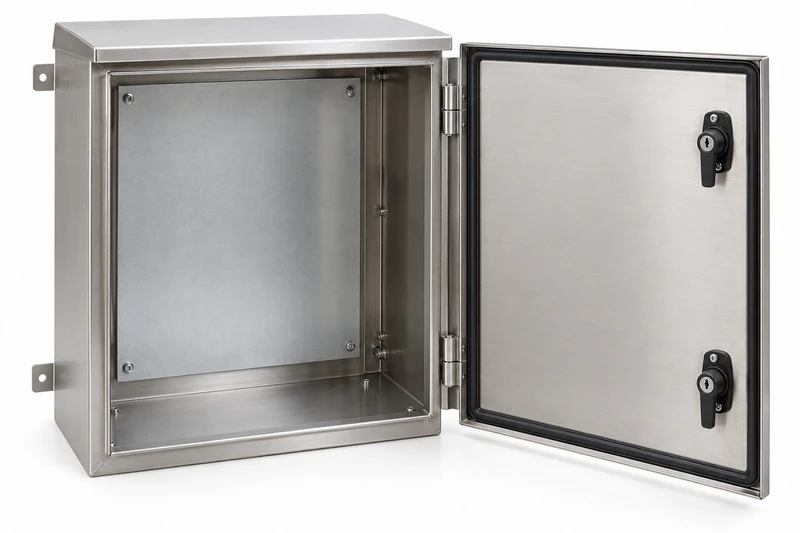
This project involved a custom stainless steel electrical enclosure for outdoor industrial equipment. The main challenge was not simply fabricating a stainless steel box and adding a gasket. The door flange, panel geometry, hinges, latches, welds, and cable-entry interfaces all had to work together after final assembly.
Even when individual sheet metal parts and cutouts meet their dimensions, sealing performance can still become unstable if welding distorts the door frame, latch pressure is uneven, or cable entries create new leak paths.
Project Overview
| Item | Details |
|---|---|
| Product | Outdoor Stainless Steel Electrical Enclosure |
| Application | Outdoor Electrical and Industrial Control Equipment |
| Material | 304 Stainless Steel; 316/316L evaluated for higher-chloride environments |
| Approx. Size | 400 × 300 × 200 mm |
| Sheet Thickness | Approx. 2.0 mm |
| Manufacturing Process | Laser Cutting, Bending, Welding, and Surface Finishing |
| Critical Interfaces | Door Flange, Gasket, Hinges, Latches, and Cable Entries |
| Protection Requirement | Project-specific IP/NEMA target, subject to specified validation |
The Manufacturing Challenge
The enclosure was intended for long-term outdoor use while maintaining reliable door closure, interface alignment, and sealing performance.
During the manufacturing review, we focused on the complete sealing system rather than simply selecting a thicker gasket. A gasket can only perform consistently when it is compressed reasonably evenly. If the door flange becomes locally distorted during bending or welding, some areas may receive insufficient compression. Excessive or uneven latch pressure can also deform the door and create another source of sealing variation.
For this reason, the critical relationship was treated as a system: door-frame geometry + door stiffness + hinge alignment + latch pressure + gasket compression + sealed interfaces.
What We Changed
1. Treating the Sealing Flange as a Functional Surface
The door flange was treated as a functional sealing surface rather than a cosmetic edge.
During bending and welding, the process sequence was planned to protect flange geometry and reduce concentrated heat input around corners and one side of the enclosure. After welding, the fit between the door and frame was checked again instead of relying only on overall enclosure dimensions.
The goal was to control gasket compression through the enclosure structure itself rather than compensate for distortion by simply increasing gasket thickness.
2. Checking Hinges, Latches, and Gasket Compression Together
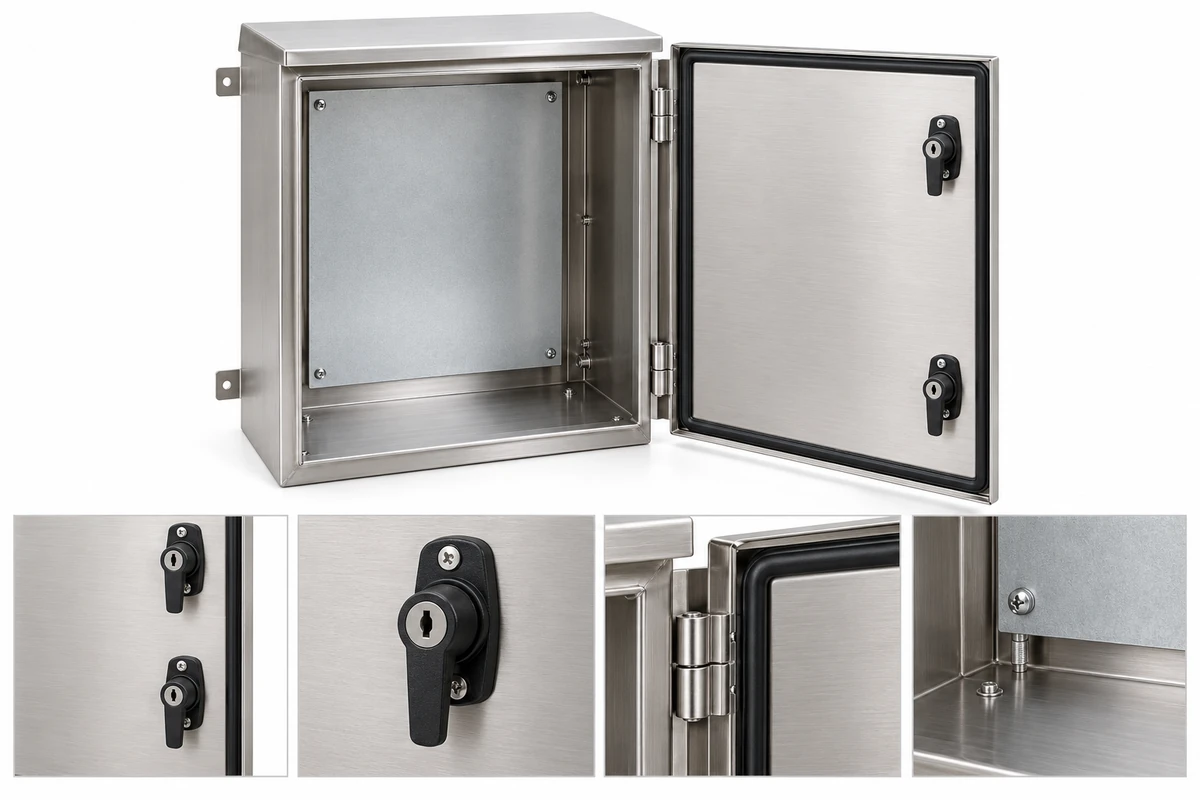
Sealing performance depends on more than the gasket material. Hinge position affects the closing path of the door, while latch quantity, location, and clamping force influence how evenly the gasket is compressed.
During trial assembly, door movement, latch alignment, and gasket contact were reviewed together to identify areas with insufficient or uneven compression before surface finishing.
3. Planning Cable Entries Before Final Fabrication
Cable glands, connectors, and other openings are potential weak points in an outdoor enclosure.
Rather than adding these features late in production, their mounting surfaces, cutout locations, fastening methods, and sealing interfaces were reviewed during the structural design stage. This also helps avoid unnecessary rework or additional cutouts after fabrication.
Restoring the Stainless Steel Surface After Welding
Welding can leave heat tint, oxidation, and localized surface contamination around the weld and heat-affected zones.
Depending on the operating environment and project requirements, these areas may require cleaning and surface restoration after welding. Typical treatments can include weld discoloration removal, brushing, pickling/passivation, or localized passivation.
For outdoor equipment, corrosion performance depends not only on the stainless steel grade but also on the condition of the surface after fabrication.
Choosing Between 304 and 316 Stainless Steel
304 stainless steel is suitable for many general industrial environments, but outdoor exposure does not represent one single corrosion condition.
For equipment exposed to coastal atmospheres, chlorides, salt spray, or other more aggressive environments, 316 or 316L stainless steel may be a more appropriate option.
Material selection should therefore be based on the actual operating environment rather than assuming one stainless steel grade is suitable for every outdoor application.
Verification Before Release
Before release, the enclosure was evaluated with emphasis on the features that directly affect installation and sealing: stable door opening and closing; door-to-frame fit; continuous and reasonably uniform gasket contact; hinge and latch alignment; cable-entry and connector interfaces; post-weld surface condition; and key dimensional relationships required for final assembly.
Where an IP65, IP66, or NEMA protection target is specified, the enclosure should be validated according to the agreed project requirements rather than assigning a rating based only on appearance or material.
Customer Value
The value of this project was not simply producing a welded stainless steel enclosure.
By considering material selection, welding distortion, sealing surfaces, latch pressure, and outdoor exposure as one manufacturing system, the enclosure could be prepared for final installation with the critical assembly and sealing relationships already addressed. This reduces the risk of field adjustment, re-drilling, or sealing rework after the enclosure reaches the customer’s equipment.
FAQ
Should I use 304 or 316 stainless steel for an outdoor electrical enclosure?
304 stainless steel is suitable for many general industrial environments. For coastal, high-chloride, salt-spray, or more aggressive environments, 316 or 316L should be evaluated. The final material should be selected according to the actual operating environment and corrosion requirements.
Can a custom stainless steel enclosure be designed for IP65 or IP66 requirements?
Yes. The enclosure can be designed around a target protection requirement, including the door flange, gasket, latches, and cable-entry interfaces. However, the final IP rating should be confirmed through the specified validation method rather than assumed from the enclosure design alone.
Is NEMA 4X the same as IP66?
No. NEMA and IP ratings do not have a direct one-to-one equivalence because the two systems cover different environmental conditions and test requirements. The appropriate standard should be selected according to the application and target market.
Why is post-weld treatment important for stainless steel enclosures?
Welding can produce heat tint and surface contamination around the weld area. Depending on the application, cleaning, pickling, passivation, or localized surface restoration can help restore a more corrosion-resistant surface condition.
What information is needed to quote a custom outdoor electrical enclosure?
Useful information includes a 2D drawing or 3D model, enclosure dimensions, material and sheet thickness, cutout requirements, hinge and latch design, sealing requirements, target IP/NEMA conditions, quantity, and the intended operating environment. If complete drawings are not yet available, the application and structural requirements can be provided for an initial review.