From Accurate Individual Parts to Reliable Final Assembly
Case note: This representative case is based on our manufacturing experience with similar industrial control cabinets. Certain project details have been anonymized or adjusted for confidentiality.
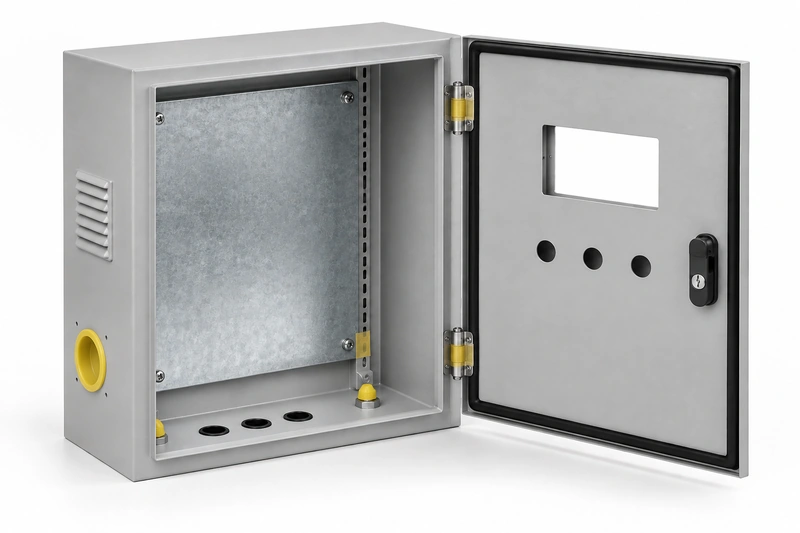
An industrial electrical control cabinet typically combines a cabinet body, door, internal mounting plate, hinges, latches, and multiple interface cutouts. From a sheet metal fabrication perspective, the challenge is not simply producing every panel to its individual drawing dimensions. Those parts still have to work together after bending, welding, pretreatment, and powder coating.
For this project, the manufacturing focus was therefore placed on the relationship between the cabinet body, door, mounting plate, and external interfaces rather than on any single isolated dimension.
Project Overview
| Item | Details |
|---|---|
| Product | Industrial Electrical Control Cabinet |
| Application | Automation and Industrial Control Equipment |
| Main Material | SPCC Cold-Rolled Steel |
| Finish | Powder Coating |
| Main Processes | Laser Cutting, Bending, Welding, Coating Pretreatment, Powder Coating, Assembly Inspection |
| Key Structures | Cabinet Body, Door, Mounting Plate, Hinges, Latches, Interfaces, and Cable Entries |
| Manufacturing Focus | Door Fit, Mounting-Plate Position, Cutout Relationships, Post-Weld Geometry, Functional Surface Protection |
The Problem Was Not One Individual Panel
During individual inspection, the cabinet body, door, and mounting plate can all remain within drawing requirements. Their accumulated relationship only becomes clear when the cabinet is assembled.
A small change at a hinge mounting surface can affect the final door gap. A dimensionally correct mounting plate can still conflict with a door interface or side cable entry if those features were established from different assembly references.
For this electrical control cabinet, we therefore reviewed the complete assembly relationship before finalizing critical cutouts, mounting locations, and the manufacturing sequence.
Establishing the Assembly Relationship Before Fabrication
Pushbuttons, switches, or HMI cutouts in the door are not isolated laser-cut features. Their positions also have to work with the hinges, door frame, internal clearance, and equipment mounted on the internal plate.
The mounting plate was handled in the same way. Its position relative to the cabinet, door, and external interfaces was reviewed before critical features were finalized.
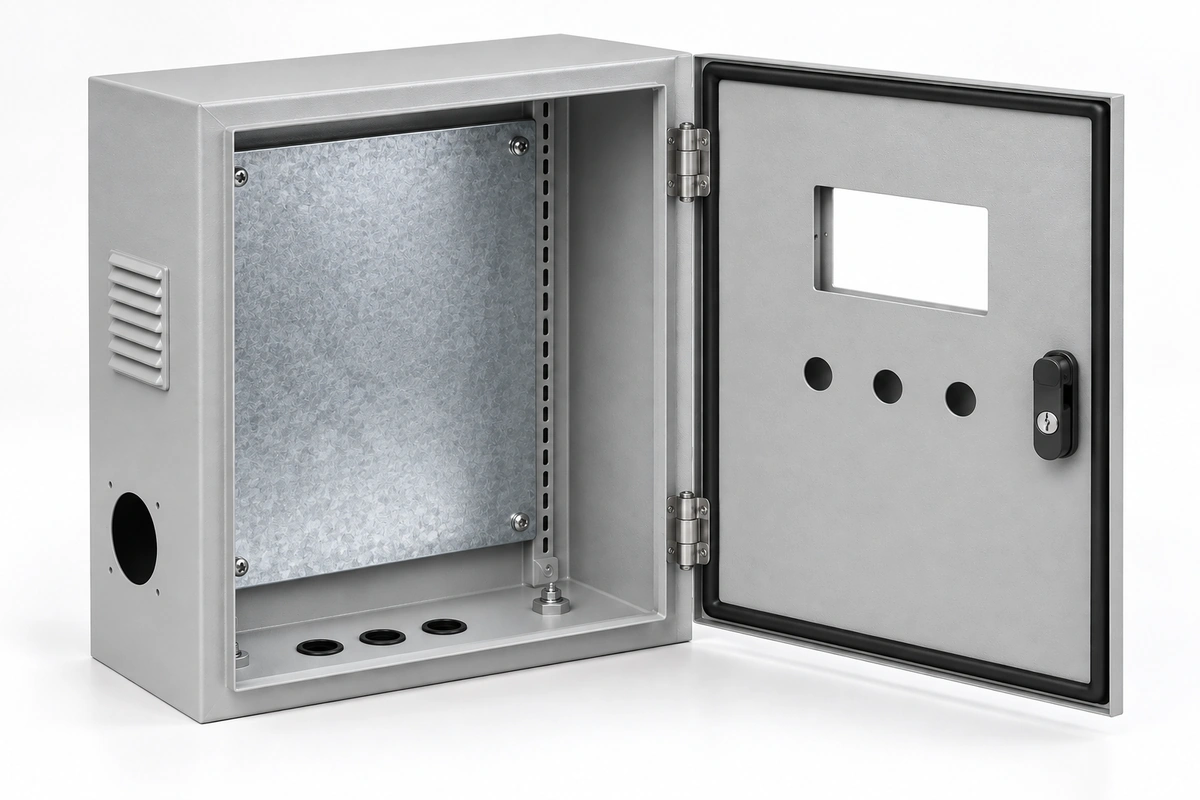
This allowed potential conflicts between internal equipment and external interfaces to be identified during fabrication rather than after the finished cabinet had already been coated.
The key change was straightforward: establish the final assembly relationship first, then manufacture the individual parts around it.
Rechecking the Cabinet After Welding
Correct cutting and bending do not guarantee that the cabinet will retain exactly the same geometry after welding.
Heat input can affect the cabinet opening, door frame, or local mounting areas. The cabinet was therefore trial-fitted again before surface finishing, with attention to door operation, hinge and latch alignment, mounting-plate position, and critical interfaces.
Any necessary mechanical adjustment could then be completed before powder coating rather than after the finished surface had been applied.
Protecting Functional Areas Before Powder Coating
A realistic steel cabinet process involves more than simply moving from welding directly to powder coating.
Before coating, the cabinet requires cleaning and an appropriate pretreatment selected according to the substrate, service environment, coating specification, and customer requirements.
Functional areas also need to be identified before coating. Threaded holes must remain suitable for later assembly, while specified grounding and bonding interfaces may need to retain the conductive condition required by the electrical design.
Masking, plugging, and thread protection are therefore planned before powder coating rather than corrected by removing coating from finished parts afterward.
Final Verification Returns to the Complete Assembly
After finishing, inspection returns to the condition in which the cabinet will actually be used.
The door is checked for normal operation, hinges and latches are reviewed for alignment, the mounting plate is installed in its intended position, and external interfaces are checked against the internal layout. Protected threaded features and grounding/bonding interfaces are also verified against the drawing requirements.
The result is not simply a set of dimensionally compliant panels, but a custom sheet metal cabinet manufactured around its final assembly requirements.
Customer Value
The value of this sheet metal cabinet fabrication project was not simply completing laser cutting, bending, welding, and powder coating.
By coordinating the cabinet body, door, internal mounting plate, external interfaces, welding effects, and coating requirements within the same manufacturing sequence, potential assembly issues could be addressed before final finishing.
This reduces the risk of post-coating drilling, thread repair, door adjustment, or changes to the internal equipment layout.
| Need a Custom Electrical Control Cabinet? If you are developing a custom electrical control cabinet, automation cabinet, or other sheet metal enclosure, send us your drawing, 3D model, or basic dimensions and application requirements. We can review material selection, manufacturability, door and mounting-plate fit, cutout layout, welding, and surface-finishing requirements before production. Discuss Your Project |
FAQ
What information is needed to quote a custom electrical control cabinet?
Useful information includes 2D drawings or a 3D model, cabinet dimensions, material and sheet thickness, door configuration, mounting-plate requirements, major cutouts, cable entries, finish requirements, quantity, and operating environment. If the major internal equipment locations are already defined, sharing that layout can also help identify conflicts between internal components and external interfaces before fabrication.
Can the mounting plate and cabinet cutouts be reviewed together before fabrication?
Yes. For a custom cabinet, the mounting plate, door interfaces, side connectors, and cable entries should be reviewed as part of the same assembly. This helps reduce the risk of external cutouts being correctly manufactured but poorly aligned with the internal equipment layout.
Why is pretreatment required before powder coating a sheet metal cabinet?
Fabrication oils and surface contamination can affect coating adhesion and performance. Cleaning and an appropriate pretreatment prepare the steel surface for the powder coating system. The specific process should be selected according to the substrate, operating environment, and coating requirements rather than applying one fixed treatment to every cabinet.
How are threaded holes and grounding areas protected during powder coating?
The required method depends on the drawing and functional requirements. Threaded holes may be plugged or otherwise protected for later assembly, while specified grounding or bonding interfaces may require masking or another controlled method to preserve the required conductive condition.
Does a metal control cabinet door always require a bonding connection?
Not necessarily. Where the applicable electrical design or standard requires a reliable equipotential connection—particularly when electrical devices are installed on the door—the enclosure should provide an appropriate bonding path. The final method should follow the project electrical design and applicable requirements.